Malaysia is a major global producer and exporter of palm oil, and maintaining consistent cleanliness and process control is critical for quality, refining efficiency, and buyer specifications.
(Source: Malaysian Palm Oil Board (MPOB), 2025)
Even small amounts of contamination can affect downstream equipment performance and product stability.
One of the most persistent and often underestimated issues in palm oil processing is fine iron (ferrous) contamination. These particles—often invisible to the naked eye—can enter the system through equipment wear, mechanical friction, and corrosion over time.
This is where palm oil magnetic separation becomes valuable. By integrating a magnetic trap for oil into processing lines, mills can strengthen CPO filtration Malaysia systems by removing ferrous contaminants early—reducing load on downstream filtration and supporting cleaner, more stable operations.
What Are Magnetic Traps in Palm Oil Processing?
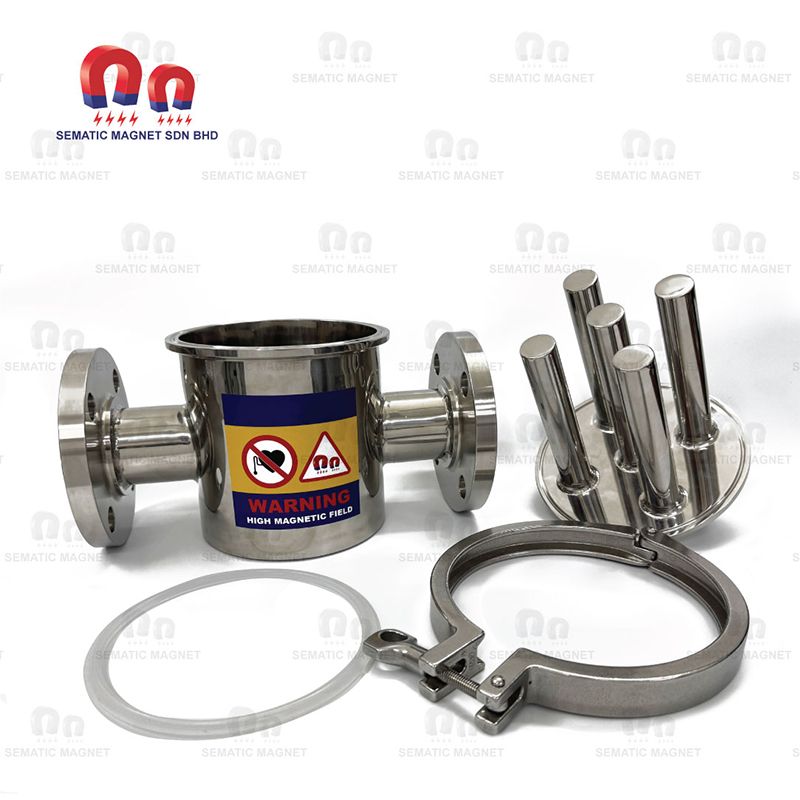
Magnetic traps are specialised inline devices designed to remove ferrous (magnetic) particles from liquid flows such as crude palm oil (CPO). They are typically installed within pipelines and serve as a supporting layer alongside conventional filtration systems.
Important note: Magnetic traps remove ferrous contaminants only. They do not remove non-ferrous metals (unless paired with other separation methods).
Key Characteristics of Magnetic Traps
- High-strength magnetic cores/rods designed to capture fine ferrous particles
- Enclosed stainless steel housing for separators commonly used in food-grade environments
- Designed for continuous inline operation without interrupting flow
- Options available for high-temperature and high-viscosity industrial applications
Unlike standard filters that rely on mesh or physical barriers, a magnetic trap uses magnetic force to pull ferrous particles out of the oil stream—helpful when ultra-fine contamination can pass through mechanical filtration.
Why Is Palm Oil Magnetic Separation Important?
Palm oil magnetic separation supports oil quality and plant reliability by removing ferrous particles before they spread through equipment or concentrate in filters.
Key Impacts of Iron Contamination
- Reduced clarity and cleanliness (visible sediment, haze, or residue)
- Higher oxidation risk (iron can accelerate deterioration and affect stability)
- Increased wear on pumps, valves, and refining equipment
- Higher filtration burden and more frequent maintenance downstream
For Malaysian palm oil mills, maintaining strong filtration practices is not only operational—it supports commercial outcomes too, because many buyers apply contractual quality specifications.
Regulatory and Quality Alignment (practical framing)
Malaysia’s palm oil sector is associated with industry oversight and quality control guidance (e.g., via MPOB publications), and export buyers may reference widely used benchmarks such as Codex-related expectations for edible oils.
(Source: Codex Alimentarius Commission, 2025, CXS 210-1999)
In practice, the most important “standard” is often the buyer/refinery spec your product must meet—magnetic separation helps reduce one common risk factor: ferrous contamination.
Common Contamination Points in Palm Oil Mills
Iron contamination can originate from multiple processing stages—often where metal surfaces experience wear, abrasion, heat stress, or corrosion.
Primary Contamination Sources
- Steriliser systems where high heat can accelerate wear in some components
- Digesters and screw presses with continuous mechanical friction
- Pipelines, pumps, and valves exposed to long-term abrasion
- Storage tanks where residue buildup and corrosion may occur
Hypothetical Example
A high-throughput mill notices inconsistent oil cleanliness despite robust mechanical filtration. An internal inspection suggests fine ferrous particles are being introduced near the screw press stage (a high-wear zone).
After adding a magnetic trap upstream of fine filtration, the mill would typically expect:
- Less ferrous residue reaching downstream filters
- Cleaner oil appearance and reduced sediment variability
- More stable filtration performance
(This is a hypothetical scenario used to illustrate typical placement and outcomes. Actual results vary based on wear conditions, flow rate, viscosity, temperature, and maintenance discipline.)
How Magnetic Traps Improve Oil Quality Outcomes
Magnetic traps can enhance cleanliness by removing ferrous particles before they contribute to sediment, filter loading, or equipment wear.
Key Benefits to Oil Quality and Operations
- Improved consistency in visible cleanliness (less sediment/metallic residue)
- Reduced burden on downstream filters (longer runtimes before clogging)
- Enhanced process stability and easier troubleshooting
- Lower risk of ferrous contamination circulating through the plant
Operational Comparison (typical)
| Parameter | Without Magnetic Trap | With Magnetic Trap |
| Ferrous contamination risk | Higher | Lower |
| Filtration load | Heavy | Reduced |
| Oil cleanliness consistency | Variable | More consistent |
| Equipment wear risk | Higher | Better controlled |
Note: “Grade” is defined by the grading/specification system used by the buyer or refinery. Magnetic traps support cleanliness, which may contribute to better spec compliance depending on the criteria used.
How Magnetic Traps Work in High-Viscosity Palm Oil
Magnetic traps create a high-intensity magnetic field that attracts and holds ferrous particles as oil flows past magnetic elements.
Step-by-Step Process
- Crude palm oil enters the magnetic trap housing
- Flow is directed across high-strength magnetic rods/cores
- Ferrous particles are attracted and retained on the magnetic surface
- Cleaner oil continues downstream with reduced ferrous contamination
Design Considerations for Palm Oil Applications
- High magnetic strength to capture fine particles
- Flow-optimised geometry to reduce pressure drop
- Materials suited for temperature and industrial conditions
- Easy-access design for cleaning and maintenance
Because palm oil is viscous, effective designs focus on keeping flow exposure consistent—so particles pass close enough to magnetic surfaces to be captured.
Additional Technical Insight
In high-throughput mills, turbulence and temperature changes affect how particles travel. Well-designed traps often account for this by:
- Increasing exposure/contact area with multi-rod magnet configurations
- Improving residence time so particles stay in the magnetic field longer
- Reducing bypass/channelling with even flow distribution
Maintenance Tips for High-Viscosity Lines
Magnetic traps require routine cleaning to keep magnetic surfaces exposed and effective. In CPO lines, residue can coat magnetic rods, reducing capture performance if left too long.
Best Practices
- Clean magnetic rods on a schedule based on what you collect (start frequent, then optimise)
- Watch for process indicators (flow issues, filter clogging patterns, pressure changes)
- Inspect seals and housing condition during maintenance windows
- Align cleaning cycles with production downtime to reduce disruption
Maintenance Frequency (practical guidance)
There’s no universal schedule that fits every mill. Frequency should be set based on:
- Throughput volume
- Equipment wear rate
- Observed contamination collection on magnets
- Viscosity/temperature profile
- Hygiene requirements and maintenance access
A common approach is to start with a conservative cleaning routine (e.g., per shift or weekly), then adjust once you understand your actual contamination pattern.
Examples and Case Studies (Hypothetical)
These examples are hypothetical illustrations intended to show how magnetic traps are commonly applied in palm oil processing. They are not claims of specific customer results.
Case Study 1: Palm Oil Mill in Johor
Challenge: Elevated ferrous contamination observed at downstream filters, affecting cleanliness consistency
Solution: Install an inline magnetic trap before fine filtration
Expected outcomes (typical):
- Lower ferrous load hitting the filters
- More stable filtration runtime
- Improved consistency in oil cleanliness
Case Study 2: Refinery Process Optimisation
Challenge: Frequent clogging in downstream filtration systems
Solution: Add magnetic separation upstream to remove ferrous particles earlier
Expected outcomes (typical):
- Lower filtration burden
- Reduced filter change frequency
- More stable processing efficiency
Integration with Existing CPO Filtration Malaysia Systems
Magnetic traps are designed to complement—not replace—traditional filtration.
How They Fit Into the Process
- Installed upstream to reduce contaminant load
- Works alongside mesh, strainers, and pressure filters
- Improves efficiency of downstream filtration by removing ferrous particles early
Process Flow Example
- Sterilisation and digestion
- Pressing and oil extraction
- Magnetic trap for oil (primary ferrous removal)
- Mechanical filtration
- Storage and refining
This layered approach supports higher reliability and better filtration performance overall. (Source: Malaysian Palm Oil Board (MPOB), 2013)
Choosing the Right Magnetic Trap for Oil
Selecting a magnetic trap depends on your operating conditions and maintenance realities.
Key Selection Factors
- Flow rate and pipeline size
- Oil viscosity and operating temperature
- Expected contamination levels (wear points, corrosion risk)
- Ease of cleaning and access (downtime planning)
- Housing grade and hygienic requirements (if applicable)
For businesses sourcing from a magnet manufacturer Malaysia or evaluating solutions from an industrial magnet shop Malaysia, it’s worth prioritising consistent performance, build quality, and maintenance practicality—not just initial cost.
Cost vs Long-Term ROI
Magnetic traps require upfront investment, but the returns often appear through reduced wear, fewer filtration problems, and more stable quality outcomes.
Cost Benefits Over Time
- Lower equipment wear and replacement costs
- Less downtime due to fewer blockages
- Reduced filter load (potentially fewer changeouts)
- Better control over contamination-related variability
For large-scale mills, even small improvements in process stability can protect output value and reduce disruption across the plant.
Using Magnetic Traps Strategically
Magnetic traps are a practical component in modern palm oil magnetic separation, helping Malaysian mills reduce ferrous contamination, strengthen CPO filtration Malaysia systems, and stabilise operations.
By placing a magnetic trap for oil strategically, especially near high-wear contamination points, mills can reduce filtration burden, limit ferrous carryover, and support cleaner, more consistent output.
At Sematic Magnet Malaysia, we design and manufacture magnetic solutions tailored for industries like palm oil. We can help you implement high-performance magnetic separation setups that improve process stability, efficiency, and long-term reliability.