Magnet strength testing is not just a technical task — it is a critical safeguard for safety, compliance, and operational reliability in Malaysian industries.
Across sectors like food processing, electronics manufacturing, and logistics, magnets are used in ways that directly impact product integrity and workplace safety. Whether it is capturing metal contaminants or supporting load-bearing applications, the reliability of these magnets depends on consistent magnet strength testing.
Many businesses begin with simple tools like a pull test kit for quick checks. However, as operations grow or customer and audit expectations increase, the need for a more structured and accurate approach — such as a magnetic field audit — becomes unavoidable.
This guide compares DIY vs professional magnet strength testing, helping Malaysian businesses understand when basic testing is sufficient and when it is time to invest in traceable, audit-ready validation.
Quick Comparison: DIY vs Professional Magnet Strength Testing
| Criteria | DIY Magnet Strength Testing | Professional Magnet Strength Testing |
| Method | Pull test kit, manual checks | Calibrated instruments, magnetic field audit |
| Accuracy | Moderate, surface/operator dependent | High, repeatable, standardised |
| Cost | Low upfront | Higher, service-based |
| Compliance readiness | Internal trending unless controls are formalised | Better aligned to QA and audit documentation |
| Use case | Internal checks, low-risk use | Industrial, safety-critical environments |
| Data output | Basic force estimation | Documented, traceable reports |
We also offer HRD Corp (HRDF) claimable Magnet Strength Testing courses for companies looking to standardize their internal quality control processes
What Is Magnet Strength Testing and Why It Matters
Magnet strength testing ensures your magnets deliver consistent performance in real-world conditions, not just in specifications.
In industrial environments, magnets are often treated as passive components. However, their performance directly affects:
- Product integrity in food production
- Precision handling in electronics manufacturing
- Load stability in lifting applications
Without proper magnet strength testing, businesses risk silent failures that only become visible after damage has occurred.
In Malaysia, food manufacturers have a legal duty to prevent unsafe or contaminated food from reaching consumers. If magnets form part of your foreign-material controls, weakened magnets can reduce your ability to manage contamination risk — which can lead to audit findings and corrective actions.
(Source: Ministry of Health Malaysia — Food Act; Ministry of Health Malaysia — Food Hygiene Regulations)
Key takeaway: Magnet performance can change over time depending on operating conditions (especially heat exposure and handling), so monitoring should be based on risk and environment. (Source: Ministry of Health Malaysia — Food Hygiene Regulations)
How to Use a Pull Test Kit
A pull test kit is the most accessible method for DIY magnet strength testing, offering a quick way to estimate holding force.
How It Works
A pull test kit typically involves attaching a magnet to a metal surface and measuring the force required to detach it. This gives a rough indication of the magnet’s holding strength.
Step-by-Step Approach
- Attach the magnet to a clean steel surface
- Connect the force gauge or scale
- Pull perpendicularly until detachment
- Record the maximum force
- Repeat multiple tests and average results
Best Practices for Accuracy
- Use consistent surface materials
- Avoid air gaps between magnet and surface
- Conduct multiple tests and average results
- Maintain the same angle and pull direction
- Record the setup (surface type, thickness, orientation)
Where It Works Best
- Warehouse storage magnets
- Basic holding applications
- Internal maintenance checks
Limitations You Should Not Ignore
- Results are highly surface-dependent
- Operator technique affects outcomes
- No standardisation across teams
- Limited documentation unless you formalise procedures
Important: A pull test kit is useful for internal monitoring, but audit readiness usually requires documented procedures, defined acceptance criteria, and calibrated/traceable equipment and records. (Source: Ministry of Health Malaysia — Food Hygiene Regulations)
What Is a Magnetic Field Audit
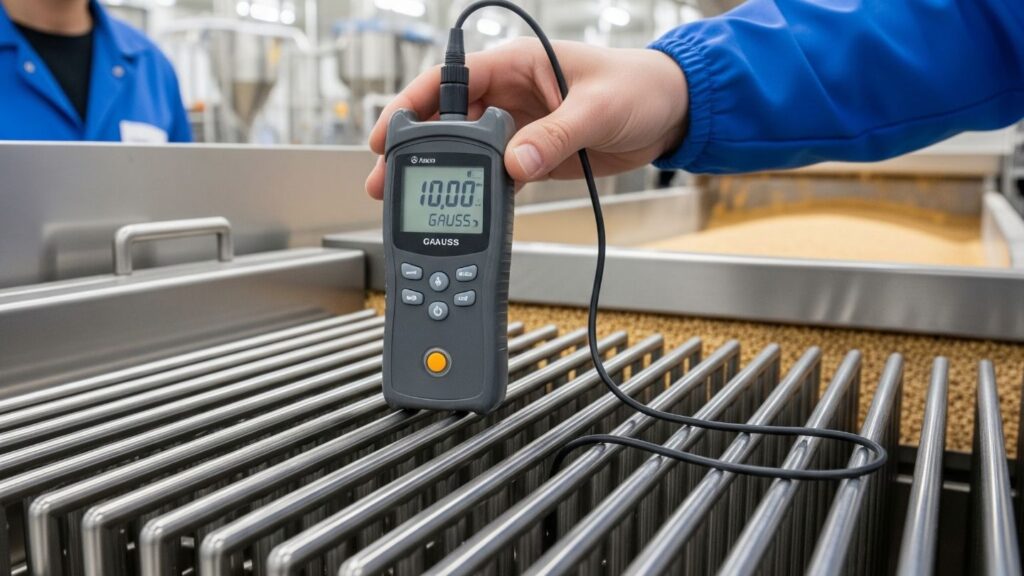
A magnetic field audit is a professional magnet strength testing process that uses calibrated instruments to measure actual magnetic performance across the magnet’s surface.
Unlike DIY methods, a magnetic field audit evaluates not just force, but the consistency and distribution of magnetic strength.
What a Magnetic Field Audit Includes
- Surface field measurement (gauss readings)
- Detection of weak or uneven zones
- Flux consistency checks / mapping across key points
- Benchmarking against internal targets or specifications
- Documentation suitable for QA records and audits
Why It Matters for Malaysian Businesses
- Supports internal quality assurance programs
- Prepares businesses for customer or third-party audits
- Helps validate supplier performance and incoming inspection criteria
For companies sourcing from a magnet manufacturer Malaysia, a magnetic field audit helps confirm magnets perform consistently under real operating conditions — not only under ideal test setups.
Comparing Accuracy and Audit-Readiness
The key difference between DIY and professional magnet strength testing lies in consistency, reliability, and documentation.
DIY Magnet Strength Testing
- Semi-quantitative measurements
- Results vary between operators
- Records are often incomplete unless formalised
- Better for trending than proof of control
Professional Magnet Strength Testing
- Calibrated and standardised measurements
- Repeatable across different conditions and sites
- Documented results with traceability
- Better suited for audits, supplier validation, and QA programs
For industries that undergo audits or require supplier validation, professional testing provides a stronger level of assurance — especially where documentation must be defensible.
Features Comparison: DIY vs Professional Magnet Strength Testing
DIY Magnet Strength Testing Features
- Low-cost entry using a pull test kit
- Easy implementation without extensive training
- Quick results for internal use
Professional Magnet Strength Testing Features
- Advanced measurement tools
- Magnetic field mapping capabilities
- Detailed reporting and traceable records
- Stronger alignment with quality and compliance expectations
Pricing Considerations (Malaysia Context)
Cost should not be evaluated in isolation — it must be weighed against operational risk and potential losses.
DIY Magnet Strength Testing Costs
- One-time purchase of a pull test kit
- Minimal ongoing expenses
- Suitable for small-scale operations
Professional Magnet Strength Testing Costs
- Service-based pricing (per audit or contract)
- Higher initial investment
- Scalable for larger operations and multiple sites
Cost vs Risk Perspective
- DIY testing minimises upfront cost
- Professional testing minimises long-term risk
For businesses working with an industrial magnet shop Malaysia, professional testing is often integrated into supplier quality control strategies.
The Cost of Getting Magnet Strength Testing Wrong
The real cost of poor magnet strength testing is rarely the test itself, but the downstream impact on operations, safety, and compliance.
Many Malaysian businesses underestimate how small inaccuracies in magnet strength testing can scale into significant operational risks. While a pull test kit may indicate that a magnet is “working,” it does not guarantee consistent performance under real production conditions.
Hidden Costs You Should Consider
- Production downtime due to unexpected magnet failure
- Product recalls caused by metal contamination
- Equipment damage from loose or weak magnetic components
- Failed audits due to lack of documented verification
- Loss of client trust, especially in export-driven industries
Food businesses are expected to maintain controls to prevent contamination and protect consumers, and failures can trigger enforcement, customer actions, and reputational damage. (Source: Ministry of Health Malaysia — Food Act; Ministry of Health Malaysia — Food Regulations)
Real-World Scenario
A food processing facility relying solely on DIY magnet strength testing may pass internal checks using a pull test kit, but still fail to capture fine metal particles during production. This gap is often discovered during a customer audit or contamination incident, resulting in costly corrective actions and reputational damage.
Why Professional Testing Changes the Equation
A magnetic field audit provides more than just measurement — it delivers traceable, standardised data that can be used for:
- Audit documentation
- Supplier validation
- Preventive maintenance planning
Key insight: The question is not whether DIY magnet strength testing works, but whether it is sufficient for the level of risk your business operates in.
Pros and Cons: Head-to-Head
DIY Magnet Strength Testing
Pros
- Low cost
- Fast and accessible
- Suitable for routine checks
Cons
- Inconsistent results
- Limited documentation unless formalised
- Limited diagnostic insight
Professional Magnet Strength Testing
Pros
- High accuracy and reliability
- Audit-ready documentation
- Suitable for critical applications
Cons
- Higher cost
- Requires external expertise
When Do You Need a Certified Technician
A certified technician becomes essential when magnet strength testing directly impacts safety, compliance, or product quality.
Clear Indicators
- Food-grade magnetic separation systems
- Regulatory or customer audits
- Expansion of production capacity
- Inconsistent results from DIY testing
- Safety-critical holding/lifting applications
For workplace safety-critical applications, employers are expected to manage risks and maintain safe systems of work. (Source: DOSH Malaysia — Occupational Safety and Health Act)
In food manufacturing, documented validation and defensible controls are often necessary to meet customer expectations and demonstrate effective contamination prevention. (Source: Ministry of Health Malaysia — Food Hygiene Regulations)
Industry Use Cases in Malaysia
Food Manufacturing
- Often uses magnets as part of foreign-material controls
- Benefits from regular verification and documented checks
- Helps support food safety and audit expectations (Source: Ministry of Health Malaysia — Food Hygiene Regulations; Ministry of Health Malaysia — Food Regulations)
Electronics Manufacturing (Penang)
- Requires high precision magnet performance
- Sensitive to field variations and placement consistency
- Benefits from mapping and repeatable measurement
Logistics and Lifting Applications
- Safety-critical magnet use
- Benefits from documented verification and preventive maintenance (Source: DOSH Malaysia — Occupational Safety and Health Act)
Hidden Factors That Affect Magnet Strength
Many businesses overlook environmental and operational factors that can significantly affect magnet performance and test results.
Key Factors
- Temperature exposure (hot product zones, thermal cycling, operating near limits)
- Surface roughness and contact quality
- Coating thickness
- Presence of air gaps or misalignment
- Handling damage and mechanical shock
- Long-term aging under stress
These variables can distort DIY magnet strength testing results, making professional evaluation more reliable in industrial environments.
Testing Frequency Framework
A structured schedule reduces unexpected failures, but frequency should be set based on risk, not guesswork.
Risk-Based Factors to Consider
- Product and contamination risk
- Magnet criticality (where it sits in the process)
- Cleaning intensity and damage likelihood
- Heat exposure and operating environment
- Incident history (near-misses, complaints, metal finds)
- Customer and audit expectations
Practical approach: Many sites combine routine internal trending checks with periodic verification using calibrated instruments and consistent documentation. (Source: Ministry of Health Malaysia — Food Hygiene Regulations)
From DIY to Professional: When to Upgrade
Most businesses begin with DIY magnet strength testing, but scaling operations introduces complexity that requires stronger validation.
Upgrade Triggers
- Increasing production scale
- Entering regulated or export-driven supply chains
- Facing customer or compliance audits
- Experiencing inconsistent magnet performance
- Needing traceable documentation and standardised reporting
Getting Magnet Strength Testing Right
Magnet strength testing is not just about measuring force — it is about protecting operations, supporting compliance, and maintaining long-term reliability.
While a pull test kit provides a useful starting point, a full magnetic field audit becomes essential as your business grows or enters higher-risk environments.
At Sematic Magnet, we help Malaysian businesses move beyond basic checks with reliable solutions from a trusted magnetic device Malaysia partner. If you are ready to ensure consistent, audit-ready performance, we are here to support your magnet strength testing and industrial needs.