For Malaysian food businesses running mills, choosing between a magnetic rod and a magnetic grate is not just a technical decision. It can affect contamination control, equipment protection, audit readiness, and overall product quality.
From flour mills in Selangor to spice processors in Penang, contamination risks may come from machinery wear, raw material impurities, or upstream handling. Without suitable foreign-material controls, even small ferrous particles can damage equipment and create food safety risks.
That is why understanding the difference between magnetic rods and magnetic grates matters. Both are used for magnetic separation, but they are typically applied in different ways. Magnetic grates are commonly installed in hoppers, chutes, and ducts, while magnetic rods or tube-based assemblies are often used in tanks, inspection points, and enclosed line applications.
Choosing the right setup depends on how your material flows, how much product you process, and how easy the system is to clean and maintain.
Quick Comparison: Magnetic Rod vs Magnetic Grate
| Feature | Magnetic Rod | Magnetic Grate |
| Structure | Single magnetic rod or tube | Multiple magnetic rods arranged in a grid |
| Typical Installation | Enclosed or controlled-flow points | Hoppers, chutes, ducts, and bulk intake points |
| Coverage | More targeted capture area | Wider capture area |
| Strength Focus | Depends on magnet material and design | Depends on magnet material, spacing, and grid design |
| Best Use Case | Controlled flow, tight spaces, enclosed systems | Bulk material flow, gravity-fed systems |
| Cleaning | May require individual handling | Some designs offer easier, faster cleaning |
| Common Applications | Tanks, inspection points, line assemblies | Hopper magnets, chute magnets, grate housings |
What Is a Magnetic Rod and How Does It Work?
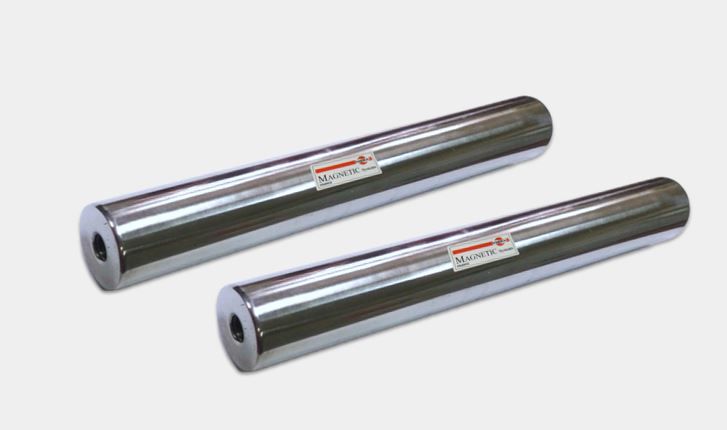
A magnetic rod, often called a magnetic tube, is a cylindrical magnetic separator used to capture ferrous contaminants in controlled flow environments.
These rods are commonly used in enclosed or controlled-flow applications, including tanks, inspection points, and some line-separator assemblies. As product passes over or around the rod, the magnetic field attracts and holds ferrous particles, helping reduce the risk of contamination moving further downstream.
Key characteristics of magnetic rods
- Compact design for tight or enclosed installations
- Capture performance depends on the magnet material and magnetic circuit
- Can be effective for fine ferrous particles and, with stronger rare-earth circuits, some weakly magnetic contaminants
- Suitable for controlled product flow
Example application
A cocoa powder processing line using enclosed transfer points may install magnetic rods to help capture fine metallic contamination generated during grinding or transfer.
What Is a Magnetic Grate and How Does It Work?
A magnetic grate is a grid of multiple magnetic rods designed to intercept ferrous contaminants in gravity-fed or bulk-flow applications.
Magnetic grates are commonly installed at raw material intake points and in hoppers, chutes, ducts, or grate housings. Their grid structure forces product to pass across several magnetic contact points, increasing the chance of contamination capture before materials move deeper into the process line.
Key characteristics of magnetic grates
- Wider capture area than a single rod
- Multiple magnetic contact points
- Well suited to bulk materials and gravity-fed systems
- Available in different layouts depending on flow rate and space
Example application
A rice mill may install a magnetic grate at the hopper inlet to help remove tramp metal before grains enter downstream milling equipment.
When to Use Magnetic Rods
Magnetic rods are best suited for applications where product flow is more controlled and installation space is limited.
They are often a strong fit when:
- Your process uses enclosed transfer points or line assemblies
- You need targeted capture in a specific section of the process
- Product flows through tanks, inspection points, or controlled channels
- Space is limited and a compact design is needed
Common use cases in Malaysia
- Spice powder transfer systems
- Food ingredient blending points
- Enclosed product inspection areas
- Processing lines with limited installation space
Why it matters
Using magnetic rods close to the product flow path can improve contamination capture without adding unnecessary bulk to the system.
When a Magnetic Grate Makes More Sense
Magnetic grates are often the better choice for bulk material handling and gravity-fed product flow.
They are commonly preferred when:
- You handle large volumes of raw material
- Product enters the process through hoppers or chutes
- You want broader coverage across the product stream
- You need pre-processing contamination control
Typical applications
- Grain intake systems
- Flour mill hoppers
- Rice and cereal handling lines
- Bulk spice or ingredient feeding systems
Why it matters
In higher-volume operations, a grate can act as an effective first-stage contamination control point before product reaches sensitive equipment.
Cleaning and Maintenance: What Is the Difference?
Cleaning efficiency is an important factor when choosing between magnetic rods and magnetic grates.
Magnetic rod cleaning
- May require removal and cleaning of individual rods or tubes
- Can involve more manual handling
- Cleaning time depends on the separator design and how it is installed
Magnetic grate cleaning
- Some systems are available with drawer-type or easy-clean housings
- These designs can reduce cleaning time and manual effort
- Often useful in operations with regular inspection and maintenance cycles
Practical takeaway
If your mill runs high volumes and needs frequent cleaning, an easy-clean grate design may reduce downtime. Still, actual maintenance performance depends on the separator design, installation, and workflow.
Magnetic Rod vs Magnetic Grate: Features Breakdown
Both systems can be effective, but they are designed for different operating conditions.
Magnetic rod features
- Compact format
- Targeted installation in controlled-flow areas
- Suitable for inspection points and enclosed applications
- Available in different magnetic strengths depending on design
Magnetic grate features
- Multiple rods in a grid layout
- Broader contact area across the product stream
- Suitable for bulk and gravity-fed material flow
- Available in single-layer or multi-layer configurations
Pricing Considerations in Malaysia
The cost of magnetic rods and magnetic grates depends on several technical and commercial factors.
Magnetic rod pricing factors
- Magnet material and strength
- Rod dimensions
- Food-grade finishing requirements
- Custom integration into existing equipment
Magnetic grate pricing factors
- Number of rods
- Grid complexity
- Frame and housing design
- Cleaning mechanism
- Installation requirements
Local factors that may affect pricing
- SST treatment
- Custom fabrication for local mill layouts
Because separator performance varies by design, price should be evaluated together with magnetic specification, product flow requirements, and ease of maintenance.
Pros and Cons: Magnetic Rod vs Magnetic Grate
Magnetic rod pros
- Compact and space-efficient
- Useful for controlled-flow applications
- Can provide strong capture performance in the right configuration
- Suitable for targeted installation points
Magnetic rod cons
- Smaller capture area than a grate
- Cleaning may be more manual
- Not always the best choice for bulk gravity-fed flow
Magnetic grate pros
- Wider capture area
- Better suited to bulk material processing
- Multiple contact points improve interception opportunity
- Easy-clean options are available on some models
Magnetic grate cons
- Larger installation footprint
- May require housing or structural adjustment
- Performance depends on magnet grade, spacing, and product flow
Food Safety and Compliance in Malaysia
Magnetic separator systems can support HACCP and GMP programmes by helping control ferrous contamination risks, but they should be selected as part of a broader hazard analysis, not treated as a stand-alone legal requirement.
In Malaysia, food premises must comply with the Food Act 1983 and the Food Hygiene Regulations 2009. For HACCP certification, facilities are expected to implement documented HACCP and PRP/GMP systems aligned with Malaysian standards.
Why this matters
When installed at the right points in the process, magnetic rods and magnetic grates can strengthen contamination control, support audit preparation, and help maintain more consistent product quality.
How to Choose the Right Option for Your Mill
The best choice depends on how your material moves through the system.
Choose magnetic rods if:
- Your process uses controlled or enclosed flow points
- Space is limited
- You need targeted capture at a specific stage
- You want a compact separator design
Choose magnetic grates if:
- You handle bulk raw materials
- Your system relies on hoppers, chutes, or gravity-fed flow
- You want broader capture coverage
- You need a practical first-stage contamination control point
Layered Protection: Using Both Together
In many mills, the best solution is not choosing one over the other. It is using both in the right places.
A practical setup may include:
- Magnetic grates at raw material intake or hopper entry
- Magnetic rods at downstream inspection or controlled-flow points
This layered approach helps improve contamination capture across multiple stages of production and reduces the chance of ferrous particles reaching critical equipment or finished product zones.
Other Practical Considerations for Malaysian Mills
Beyond choosing between rods and grates, real-world performance also depends on placement and upkeep.
Keep these points in mind:
- Install magnets before critical processing stages
- Match magnet type to actual product flow
- Inspect and clean regularly
- Include magnetic separation in your wider contamination-control plan
- Review placement during HACCP or GMP assessments
Powders, grains, and semi-processed ingredients behave differently in production. A separator that works well in one line may not be ideal in another, so product characteristics should always guide final selection.
Making the Right Magnet Choice
Choosing between a magnetic rod and a magnetic grate depends on your mill’s product flow, process layout, and maintenance priorities.
Magnetic rods are useful in compact, controlled-flow applications where targeted capture is needed. Magnetic grates are better suited to bulk handling systems where wider coverage and higher throughput matter most. In many cases, combining both provides stronger protection across the full process.
If you are planning to improve your magnetic separation setup, Sematic Magnet is an industrial magnet shop in Malaysia that can help with magnet supply, custom engineering, and testing solutions tailored to Malaysian mill operations, helping you improve contamination control, support compliance efforts, and run more efficiently.